How to Build a Home Cinema in Phuket
How to Build a Home Cinema Room in Thailand:
From Design to Installation
A complete guide to designing and building a luxury home cinema in Phuket and Thailand, covering room planning, acoustics, projectors, surround sound, lighting, smart home control and professional installation.
Introduction
A home cinema is one of the most enjoyable additions you can make to your property. Whether you're building a luxury villa in Phuket, renovating an existing home or creating a dedicated entertainment room, a properly designed cinema can provide years of enjoyment for family and friends.
Today's home cinemas offer far more than a large television and a few speakers. With 4K laser projectors, Dolby Atmos surround sound, acoustic treatments, comfortable seating and intelligent lighting, it's possible to create a private cinema experience that rivals a commercial theatre.
In Thailand, there are also some important local considerations. High humidity, tropical temperatures, large windows and open-plan villa designs can all affect how a cinema room should be planned and built.
At H3 Digital in Phuket, we design and install bespoke home cinemas that combine excellent picture and sound quality with practical, easy-to-use technology.
This guide explains the key stages involved in building a home cinema room in Thailand, from the first design drawings through to installation, calibration and ongoing maintenance.
Planning Your Home Cinema Room
Good planning is the foundation of every successful home cinema.
Before choosing a projector, amplifier or speakers, you need to consider the room itself. Its dimensions, layout, construction and intended use will all influence the final design.
Choosing the Right Room
Home cinemas can be created in many different spaces, including:
Dedicated cinema rooms: Ideal for controlling lighting, acoustics and sound isolation.
Spare bedrooms: Often suitable for compact cinemas with four to six seats.
Villa entertainment rooms: Larger spaces that can accommodate multiple seating rows and substantial screens.
Living rooms: Perfect for media rooms with large televisions or concealed projection systems.
New-build properties: An opportunity to plan cabling, lighting, air conditioning and acoustics before construction begins.
In Phuket, many modern villas have large windows, sliding glass doors and high ceilings. These look attractive, but they can create challenges for a home cinema.
Glass reflects sound and allows daylight into the room, while high ceilings and hard surfaces can produce excessive reverberation.
These problems can be addressed through careful design, suitable window coverings and acoustic treatment.
The Importance of Professional Design
At H3 Digital, we use detailed drawings and 3D visualisations to plan cinema rooms before installation begins.
Our designs consider:
Screen size and viewing distances.
Seating positions and sightlines.
Speaker locations and Dolby Atmos layouts.
Subwoofer placement.
Acoustic treatment and sound isolation.
Lighting positions and control systems.
Air conditioning and ventilation.
Equipment racks and cable routes.
Using 3D design software such as SketchUp allows you to see how your finished cinema will look before committing to construction.
It also helps identify potential problems early, when changes are easier and less expensive to make.
A good cinema design ensures that all the components work together, rather than relying on expensive equipment to compensate for a poorly planned room.
Room Layout and Cinema Design
The layout of your cinema has a major influence on picture quality, sound performance and comfort.
The relationship between screen size, viewing distance and seating position should be established before the room is fitted out.
Screen Size and Seating Distance
A larger screen does not automatically mean a better cinema.
If the screen is too large for the viewing distance, watching films can become uncomfortable. If it's too small, you lose the sense of immersion that makes a dedicated cinema special.
For many home cinema designs, a horizontal viewing angle of approximately 36 to 45 degrees provides an immersive experience, although personal preference and the type of content also matter.
A room measuring approximately 4 metres by 5 metres, for example, may comfortably accommodate a projection screen around 120 inches, depending on the seating arrangement and equipment selected.
Seating and Sightlines
Comfort is just as important as picture and sound quality.
Cinema seating options include individual reclining chairs, large sofas, custom-built seating and tiered arrangements.
For larger villa cinemas, a raised second row can provide clear views over the seats in front.
The height of the platform must be calculated carefully, taking into account screen position, seat dimensions and the viewing angles of each row.
We also consider walkways, access to seats and the position of lighting controls.
Designing for Future Upgrades
Technology changes, but a well-designed cinema room should last for many years.
Installing suitable cable routes, spare conduits and accessible equipment racks makes future upgrades considerably easier.
This is particularly useful in Thailand, where some specialist equipment may need to be ordered from overseas.
Projectors, Screens and Large Televisions
The display is usually the most noticeable part of a home cinema.
Choosing between a projector and a large television depends on the room, the amount of daylight and how you intend to use the space.
4K Laser Projectors
For dedicated cinema rooms, a projector is often our preferred solution.
Modern 4K laser projectors can deliver impressive image quality on screens measuring 100 to 150 inches or more, depending on the room and projector specification.
Advantages include:
Large, immersive images.
Excellent performance in controlled lighting conditions.
Long-lasting laser light sources.
No traditional projector lamps to replace.
Flexible screen sizes and formats.
Projectors work particularly well in dedicated rooms where daylight can be controlled.
In Phuket, blackout curtains or blinds are often essential, especially in villas with large windows.
Large-Format Televisions
For living rooms and multipurpose entertainment spaces, a large television may be more practical.
Premium OLED and Mini LED televisions provide high brightness, strong contrast and excellent picture quality.
They are particularly suitable for rooms used for daytime television, sports and gaming.
Choosing the Right Screen Format
Two common screen formats are:
16:9: Suitable for television, streaming services, gaming and most sports coverage.
2.35:1 Cinemascope: A wider format particularly suited to films, providing a traditional cinematic presentation.
We can also install acoustically transparent projection screens, allowing the front speakers to be positioned behind the picture.
This helps dialogue appear to come directly from the actors on screen.
For multipurpose rooms, motorised projection screens can be concealed when not in use, preserving the appearance of the living space.
Surround Sound and Room Acoustics
Sound is one of the biggest differences between a basic entertainment system and a properly designed home cinema.
A well-designed surround sound system makes dialogue clearer, creates convincing movement around the room and adds impact to action scenes.
However, the room itself has a major influence on how the system performs.
Choosing a Surround Sound System
Common configurations include:
5.1 Surround Sound: Five main speakers and one subwoofer. A practical option for smaller cinema rooms and media rooms.
7.1 Surround Sound: Seven main speakers and a subwoofer, providing additional surround coverage.
Dolby Atmos: Adds overhead speakers to create a three-dimensional sound field.
Popular Dolby Atmos layouts include 5.1.2, 5.1.4 and 7.1.4 systems.
For larger luxury cinemas, more speakers and multiple subwoofers may be appropriate.
At H3 Digital, we design speaker layouts around the room and seating positions rather than simply installing as many speakers as possible.
Why Subwoofers Matter
Subwoofers reproduce the low-frequency effects that give films their physical impact.
Explosions, engines, thunder and film soundtracks all benefit from accurate, controlled bass.
In many rooms, using two subwoofers can improve bass consistency across multiple seating positions.
The correct locations depend on the room's dimensions, construction and acoustic behaviour.
Acoustic Treatment
Even excellent speakers can sound disappointing in an untreated room.
This is especially relevant in Thailand, where many properties feature tiled floors, concrete walls, large glass panels and other reflective surfaces.
These materials can create unwanted echoes and reflections, reducing dialogue clarity and making the sound tiring to listen to.
Acoustic treatments may include:
Absorption panels to control early reflections.
Bass traps to manage low-frequency problems.
Diffusers to scatter sound.
Acoustic curtains and suitable floor coverings.
Fabric wall systems that conceal speakers and treatments.
The aim is to create a balanced acoustic environment, rather than making the room completely dead.
Soundproofing Your Cinema
Soundproofing and acoustic treatment serve different purposes.
Acoustic treatment improves the sound inside the cinema. Soundproofing reduces the amount of sound travelling into and out of the room.
For villas with neighbouring bedrooms, adjoining living spaces or nearby properties, sound isolation can be particularly important.
Depending on the construction, solutions may include isolated wall linings, additional mass, acoustic doors and carefully sealed openings.
In concrete buildings, low-frequency sound can still travel through the structure, so sound isolation needs to be considered early in the design.
Home Cinema Lighting Design
Lighting has a major effect on the atmosphere of a cinema room.
A well-designed system should provide enough light for people to enter, move around and find their seats, while allowing the room to become suitably dark during a film.
Layered Cinema Lighting
We typically combine several types of lighting:
Recessed downlights: General illumination when entering or cleaning the room.
LED strip lighting: Concealed lighting around ceilings, wall features and seating platforms.
Step lighting: Low-level illumination for safe movement.
Wall lighting: Decorative lighting to highlight architectural details.
Star ceilings: Fibre-optic lighting that creates a night-sky effect above the seating area.
Each lighting circuit can be controlled independently, allowing different scenes to be created.
Intelligent Lighting with Control4
At H3 Digital, we specialise in integrating lighting with smart home control systems, including Control4.
For example, selecting a Movie scene could:
Turn on the projector and audio system.
Select the correct entertainment source.
Close motorised curtains or blinds.
Dim the main lighting.
Leave subtle step lighting illuminated.
At the end of the film, a single button can raise the lighting and return the room to normal.
This makes the cinema straightforward for everyone in the family to use.
Smart Home Technology and Cinema Control
A modern cinema may contain a projector, amplifier, media player, streaming devices, lighting system, air conditioning and motorised blinds.
Without proper integration, operating everything can become unnecessarily complicated.
One Simple Control System
We design cinema systems so that everyday operation is as simple as possible.
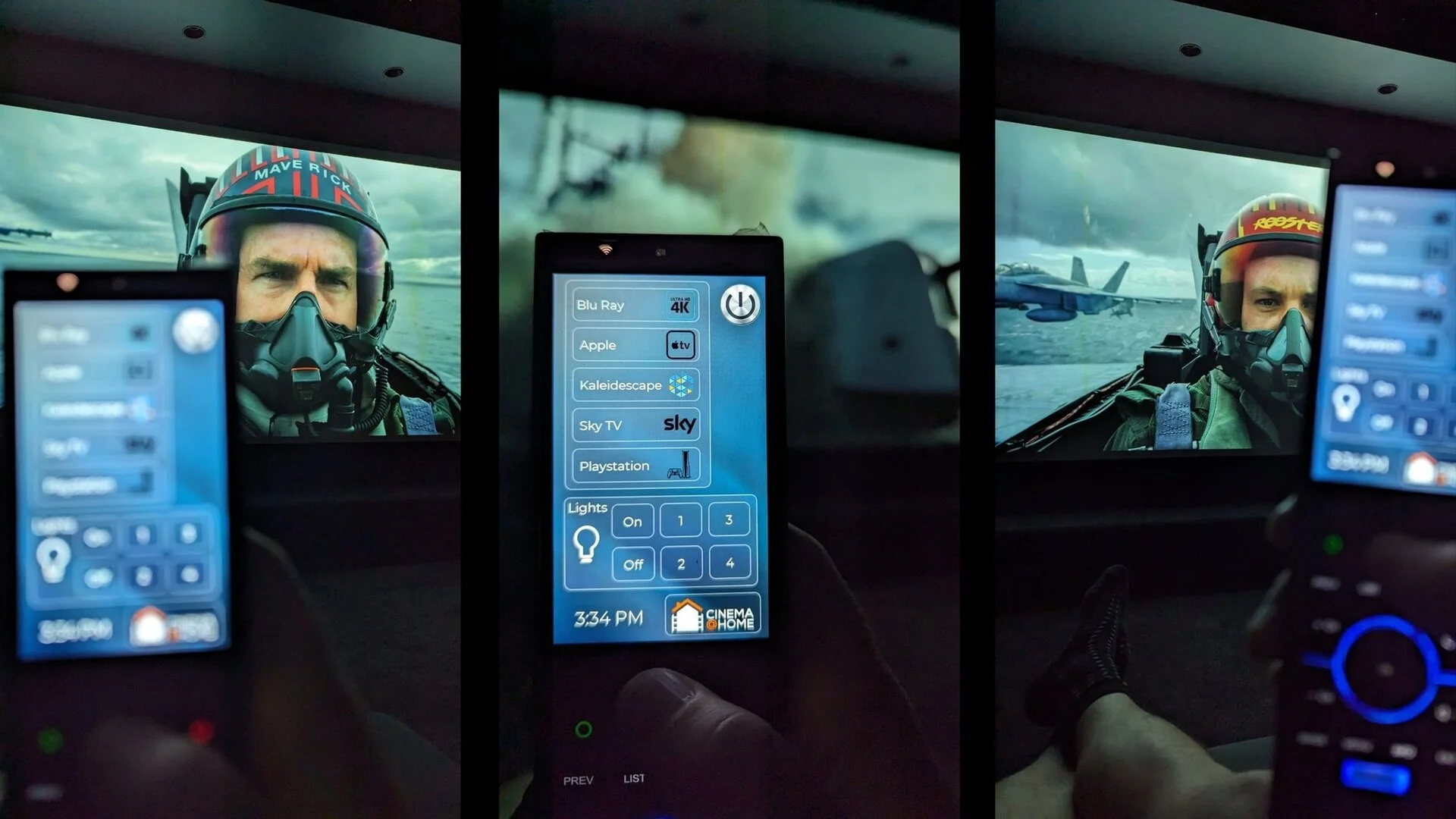
With Control4, compatible equipment can be brought together through a single remote, touchscreen or smartphone interface.
Depending on the equipment and integration available, you can control:
Projectors and televisions.
Surround sound systems.
Streaming devices and media players.
Lighting scenes.
Motorised curtains and blinds.
Air conditioning.
Other connected smart home systems.
For larger properties, the cinema can also form part of a wider home automation installation.
AV Racks and Equipment Organisation
A professionally designed AV rack keeps amplifiers, processors, network equipment and media players organised in one location.
This provides several advantages:
Neat, labelled cabling.
Better equipment accessibility.
Easier maintenance and troubleshooting.
Improved ventilation.
Space for future upgrades.
In Phuket's tropical climate, equipment ventilation deserves particular attention.
Amplifiers and processors can generate considerable heat, especially in larger Dolby Atmos installations.
Racks should have adequate airflow and be installed in a suitable environment. Where necessary, temperature-controlled ventilation or dedicated cooling can be incorporated.
Reliable Home Networking
Modern entertainment systems depend heavily on a stable network connection.
Streaming 4K video, controlling smart home equipment and distributing music throughout a villa all require reliable connectivity.
At H3 Digital, we also design and install home networking systems using Ubiquiti UniFi equipment.
A properly planned network helps ensure your cinema, smart home controls and other connected devices operate reliably.
Designing a Cinema for Thailand's Tropical Climate
Building a cinema in Thailand involves some considerations that are less significant in cooler climates.
Heat, humidity and moisture can affect electronic equipment, construction materials and interior finishes.
Humidity Control
High humidity can encourage mould growth and damage sensitive materials.
Cinema rooms should be designed with appropriate air conditioning and humidity management.
This is particularly important for rooms that remain closed for long periods, such as cinemas in holiday villas.
Air Conditioning and Noise
Air conditioning is essential for comfort in Thailand, but poorly designed systems can introduce unwanted background noise.
A noisy indoor unit positioned directly above the seating area can become distracting during quiet film scenes.
Where possible, we consider air conditioning locations, airflow and noise levels during the design stage.
The aim is to keep the room comfortable without compromising the listening experience.
Choosing Suitable Materials
Interior materials should be selected with Thailand's climate in mind.
Depending on the room conditions, moisture-resistant construction materials, suitable adhesives and appropriately specified fabrics may be beneficial.
Acoustic panels and fabric wall systems should be installed in a controlled environment to reduce the risk of moisture-related problems.
The same care applies to projector locations, AV racks and concealed electronics.
Power Protection
Electrical supply quality and lightning-related surges are also worth considering, particularly in larger villas.
Appropriate surge protection, earthing and UPS systems for selected equipment can help protect the installation and reduce disruption.
These systems should be specified and installed by suitably qualified professionals.
Interior Design and Finishing Touches
A home cinema should look as good as it sounds.
The interior design can range from a traditional dark cinema with individual reclining seats to a modern entertainment room that complements the rest of a luxury villa.
Fabric Wall Systems
Fabric tracking systems are an excellent option for dedicated cinema rooms.
They allow acoustic panels, speakers and cabling to be concealed behind a clean, continuous fabric finish.
The result is a professional appearance without visible acoustic panels or equipment dominating the room.
Cinema Seating
Seating should be selected for comfort, dimensions and the available space.
Options include:
Individual electric recliners.
Luxury cinema chairs with cup holders.
Large sofas for family viewing.
Custom seating platforms.
Tiered seating for larger rooms.
In Phuket, we also consider how seating materials perform in air-conditioned rooms and during periods of high humidity.
Colours and Finishes
Dark, low-reflectance colours are generally best for dedicated projection rooms.
They help prevent light from reflecting around the space and washing out the image.
Charcoal, deep grey, dark blue and other muted colours are popular choices.
For multipurpose living rooms, lighter finishes can still work well, particularly when combined with suitable lighting control and a bright display.
Multipurpose Cinema and Media Rooms
Not every property needs a dedicated cinema.
In many Phuket villas, homeowners prefer a flexible entertainment space that can be used for films, music, gaming and everyday television.
A multipurpose media room can combine:
A large television or concealed projector screen.
Discreet in-wall or in-ceiling speakers.
Dolby Atmos surround sound.
Smart lighting.
Comfortable family seating.
Control4 automation.
Integration with multi-room music systems.
For example, a living room could have a large television for daytime viewing and a motorised projection screen for evening films.
The lighting and audio system can automatically adjust to suit each activity.
For homeowners who enjoy entertaining guests, a media room can also integrate with outdoor terraces, poolside audio and other entertainment areas.
This is particularly useful in Phuket's villa lifestyle, where indoor and outdoor spaces often form part of the same entertainment system.
Professional Home Cinema Installation
Once the design is complete, the installation process can begin.
A professionally installed cinema requires coordination between several trades, particularly on new-build properties and major renovations.
Installation Stages
A typical project involves:
Stage 1: Design and Specification
We establish the room layout, screen size, speaker configuration, lighting requirements and equipment specification.
Stage 2: First-Fix Wiring
Speaker cables, network cables, HDMI connections, control wiring and other infrastructure are installed before the walls and ceilings are finished.
Stage 3: Construction and Acoustic Treatment
The room is prepared, including any required sound isolation, acoustic treatment, ceiling work and seating platforms.
Stage 4: Interior Finishes
Fabric walls, flooring, lighting, seating and decorative finishes are installed.
Stage 5: Equipment Installation
Projectors, screens, speakers, amplifiers, subwoofers and AV racks are fitted and connected.
Stage 6: Programming and Calibration
We configure the control system, test the equipment and calibrate the audio and video performance.
Audio and Video Calibration
Correct calibration is essential to achieving the best performance from your equipment.
Audio calibration helps balance speaker levels, timing, frequency response and subwoofer integration.
Video calibration and setup help ensure the projector or television produces accurate, consistent images under the room's viewing conditions.
The final result should provide excellent performance across the seating area, rather than only at one position.
Maintenance and Long-Term Reliability
A home cinema is a long-term investment, and proper maintenance helps keep it performing reliably.
In Thailand, this is particularly important because of heat, humidity and environmental conditions.
Regular maintenance may include:
Checking and cleaning projector filters where fitted.
Inspecting AV rack ventilation.
Updating equipment firmware.
Checking network and control system operation.
Inspecting cables and connections.
Reviewing audio calibration.
Checking air conditioning and humidity conditions.
For holiday villas and properties that are not occupied throughout the year, preventative maintenance can help identify problems before guests or owners arrive.
At H3 Digital, we design systems with accessibility, reliability and long-term support in mind.
Why Choose H3 Digital for Your Home Cinema in Phuket?
H3 Digital specialises in home cinema, smart home technology, lighting control and integrated audio systems in Phuket, Thailand.
Our approach combines detailed design, technical expertise and practical installation experience.
With more than 20 years of experience in home cinema and smart home systems, we understand the importance of getting the fundamentals right.
Our expertise includes acoustic design, surround sound systems, Control4 automation, professional AV installation and system integration.
What We Offer
Bespoke Cinema Design
Every room is designed around the property, the equipment and how you intend to use the space.
3D Design and Visualisation
Detailed layouts and renders help you understand the finished room before construction begins.
Professional Audio and Acoustics
Speaker placement, subwoofer integration and acoustic treatment are considered from the earliest stages.
Smart Home Integration
Control4 systems can integrate your cinema with lighting, air conditioning, blinds and other compatible smart home equipment.
Complete Project Coordination
We work alongside homeowners, architects, interior designers and building contractors to coordinate the technical elements of the installation.
Ongoing Support
Our focus is on providing systems that are straightforward to operate, maintain and upgrade.
Whether you're building a dedicated luxury cinema in a Phuket villa or adding a media room to an existing property, H3 Digital can help you plan and install the right solution.
Frequently Asked Questions About Building a Home Cinema in Thailand
How much does a home cinema cost in Phuket
The cost depends on the room size, construction work, equipment, acoustic treatment and interior finishes.
A dedicated luxury cinema with a large projection screen, Dolby Atmos audio, acoustic walls, smart lighting and bespoke seating will require a larger budget than a living room media system.
At H3 Digital, we can develop a design and equipment specification around your requirements and budget.
What size room do I need for a home cinema?
A room measuring approximately 3 metres by 4 metres can accommodate a compact cinema, depending on the seating and equipment layout.
Larger rooms provide more flexibility for multiple seating rows, bigger screens and additional speakers.
Can I build a home cinema in an existing villa?
Yes. Many existing villas in Phuket can be adapted to include a dedicated cinema or media room.
The main considerations are room dimensions, lighting, acoustics, air conditioning and access for cabling.
Is a projector or large television better in Thailand?
For a dedicated dark cinema room, a projector is often the preferred option because of the large image size.
For bright living rooms with large windows, a premium television may be more practical.
The right choice depends on the room and how you intend to use it.
Do I need Dolby Atmos for my home cinema?
Dolby Atmos is an excellent option for creating immersive surround sound, particularly in dedicated cinema rooms.
However, a well-designed conventional surround sound system can also deliver excellent results.
The speaker layout should suit the room rather than being chosen purely by the number of speakers.
Can a cinema be integrated with Control4?
Yes. Control4 can integrate compatible cinema equipment with lighting, motorised blinds, air conditioning and other smart home systems.
This allows the room to be operated through simple preset scenes.
Does humidity affect home cinema equipment in Phuket?
Yes. Excessive humidity can affect electronics, interior materials and some acoustic treatments.
Suitable air conditioning, ventilation and humidity management help protect the room and its equipment.
Can H3 Digital work with my architect or villa builder?
Yes. We can coordinate with architects, interior designers and contractors to plan wiring, equipment locations, lighting and acoustic requirements.
Involving us early in the construction process helps avoid unnecessary alterations later.
How long does it take to build a home cinema?
Installation time depends on the size and complexity of the project.
A straightforward media room installation may take only a few days once the space is ready, while a dedicated cinema involving construction, acoustic treatment and custom interiors may take several weeks.
Equipment availability and coordination with other trades can also affect the schedule.
Can I have a home cinema and multi-room audio system in the same villa?
Yes. A cinema can be integrated with a wider entertainment system, including Sonos, Control4 and other compatible audio equipment.
This allows music to be enjoyed throughout the property while keeping the cinema optimised for films.
Ready to Build Your Home Cinema in Phuket?
Whether you're designing a new luxury villa, renovating an existing property or converting a spare room into a private cinema, good planning makes all the difference.
At H3 Digital, we combine home cinema design, acoustics, audio visual technology and smart home integration to create entertainment spaces that are enjoyable, reliable and easy to use.
From the initial design and 3D visualisations through to installation, programming and calibration, we can help you create a cinema room tailored to your home.
Contact H3 Digital to discuss your home cinema project in Phuket or Thailand.
📞 076 620 116
Phuket's Smart Home Experts - Cinema, Audio & Lights